Oman Wastewater Market Insight: Policy Shifts, Execution Challenges, and the Case for Intelligent Treatment
- release date: 2026-03-19 13:45:21
- author: Hongtai Huairui
- Reading: 721
- key words: Wastewater Treatment in Oman/Integrated Wastewater Treatment Equipment/Reclaimed Water Utilization / Reuse/ntelligent Wastewater Treatment System/Off-grid Wastewater Treatment/Modular Wastewater Treatment Equipment
I. A Water Crisis That Cannot Be Deferred
Oman is among the most water-scarce countries in the world. Per capita renewable freshwater availability stands at approximately 100 cubic meters per year — less than one-sixth of the global average. Over the past decade, annual rainfall has declined by roughly 20%. Under the Oman Vision 2040 framework, sustainable water resource management has been designated a national priority.
To address this structural challenge, the Omani government has committed over $29 billion toward water and wastewater infrastructure between 2025 and 2050, with more than 70% directed at treated wastewater reuse systems. This is not a discretionary expenditure — it is a foundational infrastructure commitment tied directly to the country's long-term viability.
II. Core Challenges: The Bottleneck Is Execution
Oman's wastewater difficulties do not stem from a lack of funding or policy awareness. The constraints are systemic, concentrated at the execution layer of infrastructure delivery.
Critically low network coverage. Even in Muscat, the sewerage network historically reached fewer than 14% of residents. Rural and remote governorates remain largely unserved, with the majority of households still reliant on septic systems.
Groundwater contamination risk. Inconsistent construction and maintenance of septic infrastructure has led to chronic overflow and leakage, quietly degrading shallow groundwater quality across affected areas — compounding an already strained resource base.
Last-mile failure in wastewater reuse. Even when treated effluent meets discharge standards, it frequently fails to reach agricultural or industrial end-users. The distribution infrastructure and community adoption mechanisms necessary to close the loop are largely absent. Regulatory compliance at the treatment stage does not translate to actual reuse — a defining tension in Oman's water management challenge.
Large investment gap and persistent operational pressure. Infrastructure investment needs are estimated to exceed $13.3 billion through 2045. The dispersed, off-grid nature of many deployment sites places additional demands on equipment reliability and lifecycle cost performance.

III. Policy Landscape: The Regulatory Floor Has Shifted
Oman's policy framework for wastewater management has strengthened considerably in recent years, with compliance requirements now materially elevated.
In 2023, the Ministry of Agriculture, Fisheries and Water Resources enacted regulations requiring all new residential and commercial developments to install integrated on-site wastewater treatment systems, with treated water meeting defined quality thresholds before use in irrigation or other non-potable applications. The regulations also established compliance monitoring and periodic reporting obligations.
This policy shift moves wastewater treatment from an optional feature to a mandatory compliance baseline — and it clearly defines the technical profile of viable solutions: independence from centralised sewer networks, site-adaptive modular deployment, and consistent long-term effluent quality.
Oman has also completed a broader institutional restructuring of its water sector, consolidating operations under the Oman Water and Wastewater Services Company (OWWSC), strengthening governance and creating a more coherent framework for market participation.
IV. The Technology Opportunity: Where Intelligent Integrated Systems Fit
The convergence of tightening regulation and expanding investment creates a well-defined set of requirements for technical solutions entering the Omani market:
- Off-grid operational capability— suitable for residential communities, tourism developments, industrial parks, and remote settlements beyond the reach of municipal infrastructure;
- Real-time intelligent process control— the ability to detect influent variability and automatically optimise treatment processes to maintain consistent effluent compliance;
- Low lifecycle operating costs— meeting the long-term sustainability requirements of local governments and private developers operating at scale.
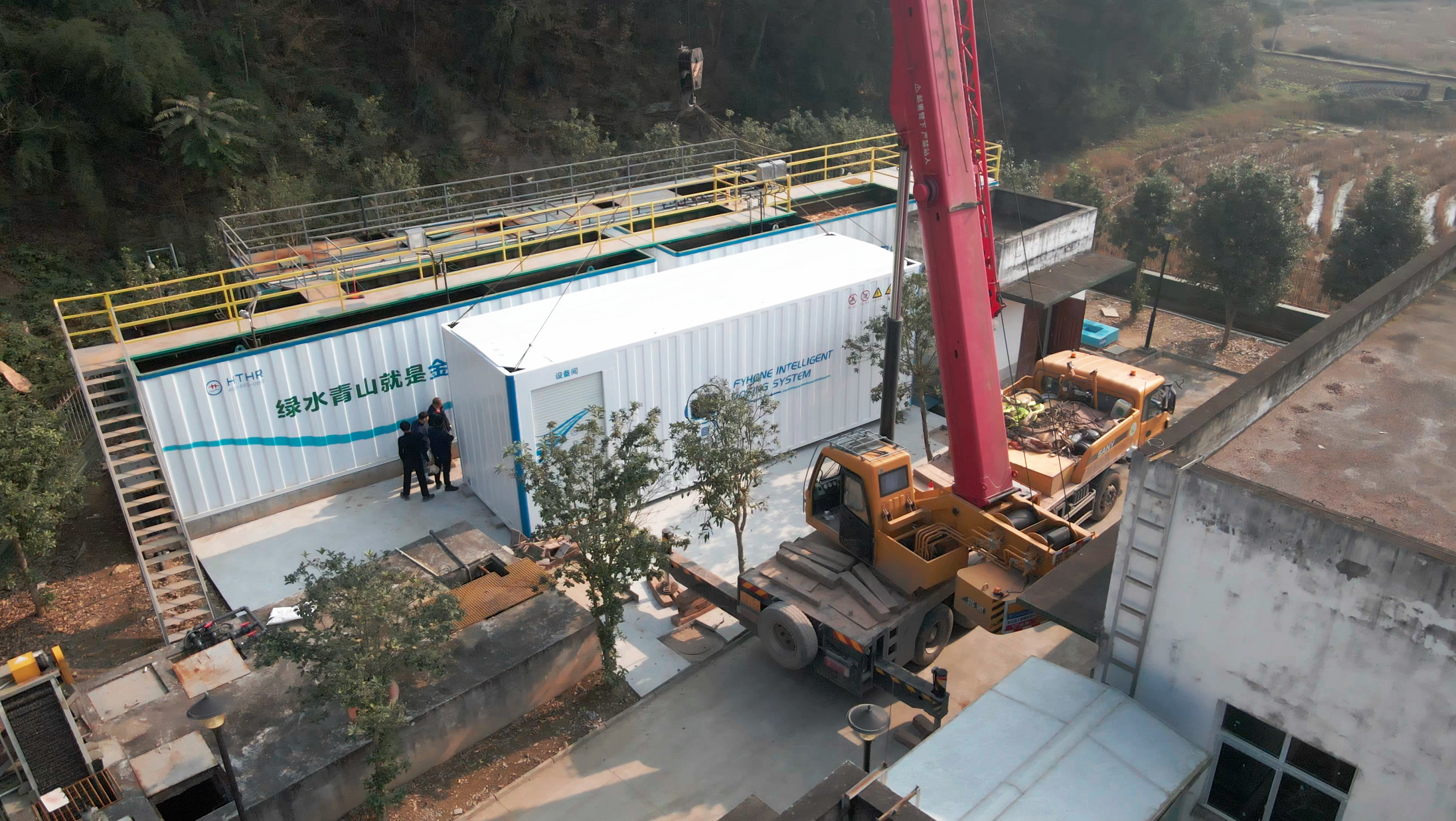
Hongtai Huarui Technology Group's Smart Integrated Wastewater Treatment System, powered by the proprietary AI FyhoneOS, was designed around precisely these requirements. The FyhoneOS provides continuous water quality monitoring and AI-driven process optimisation to ensure stable effluent compliance. A modular architecture supports right-sized deployment and scalable expansion. Full independence from large-scale municipal networks significantly reduces both capital and operational expenditure across the asset lifecycle.
The system is applicable across residential communities, hospitality and resort developments, industrial zones, and rural settlements — enabling compliance with Oman's 2023 regulatory requirements while closing the reuse gap by returning treated water directly to on-site irrigation or industrial applications.
V. Conclusion
Oman's wastewater sector has the capital allocation and policy momentum to support significant infrastructure expansion. What remains scarce are solutions that perform reliably under real operating conditions — deployable, maintainable, and consistently compliant over the long term.
As the 2023 regulatory mandate takes effect and the $29 billion investment programme advances, the technology window for intelligent integrated treatment systems is opening rapidly.
For further information on Hongtai Huarui's Smart Integrated Wastewater Treatment System and the FyhoneOS, please contact us directly.
Hongtai Huarui Technology Group Co., Ltd. Official Website | Contact Email | Business Enquiries


 hthrjt2017@gmail.com