Hongtai Huarui Technology Group welcomes your visit. We have been dedicated to the environmental protection and governance industry for over a decade! We look forward to a cooperation with you!

National Service Hotline :400-669-0860
  • Follow WeChat
  • Follow Douyin
Waste gas treatment from garbage station
  • Release date: 2022-09-14 08:44:59
  • Author: 鸿泰华瑞
  • Reading: 5155

  • Key words: Waste gas treatment, waste gas treatment equipment, organic waste gas treatment equipment, waste gas treatment company, Sichuan Hongtai Huarui

Project Overview

 Urban waste is now a major governance issue in urban construction. In recent years, the government has paid more and more attention to the management of garbage stations. At the same time, the management of garbage transfer stations and the treatment of garbage odor have become more and more strict. The fundamental cause of the generation of smelly waste gas in garbage stations is the intermediate products formed by incomplete decomposition caused by anaerobic state during the decomposition of organic matter. The organic matter in the garbage is decomposed by bacteria to produce ammonia, hydrogen sulfide, phosphine, etc. Among them, ammonia gas has a pungent smell, and hydrogen sulfide and phosphine have the smell of rotten eggs.

Design basis

(1) Information related to this project provided by the owner
(2) Environmental Protection Law of the People's Republic of China (2015-01-01)
(3) Air Pollution Prevention and Control Law of the People's Republic of China (2016-01-01)
(4) Ambient air quality standard (GB3095-2012)
(5) Decree of the President of the People's Republic of China No. 72 "Cleaner Production Promotion Law of the People's Republic of China"
(6) National Environmental Protection "13th Five-Year Plan"
(7) Comprehensive Emission Standard for Air Pollutants (GB16297-1996)
(8) "Odor Pollutant Emission Standard" (GB14554-1993)
(9) Design Code for Environmental Protection of Construction Projects (GB50483-2009)
(10) Design Code for Heating, Ventilation and Air Conditioning (GB50019-2003)
(11) Code for Fire Protection of Architectural Design (GB50016-2014)
(12) Design Code for Power Supply and Distribution System (GB50052-2009)
(13) "Volatile Organic Compound Control Emission Standard for Industrial Enterprises" DB13/2322-2016


Design principles

       (1) Assist enterprises to adopt scientific and reasonable collection methods, and minimize the amount of gas under the premise of achieving the collection effect.

(2) Actively and steadily adopt new technologies and new equipment, and adopt advanced and reliable pollution control technology in combination with the current situation and management level of the enterprise, and strive to achieve stable operation, low cost, convenient management and easy maintenance, so as to achieve the purpose of completely eliminating exhaust gas pollution and protecting the environment. (2015-01-01)
(3) Properly solve the pollutants generated during the construction and operation of the project to avoid secondary pollution.
(4) Strictly implement the current national and local norms, regulations and standards promulgated by fire prevention, safety, health, environmental protection, etc.
(5) Choose new, high-efficiency and low-noise equipment, and pay attention to energy conservation and consumption reduction.
(6) The general layout strives to be compact, reasonable, smooth, simple and practical. Try to reduce the land occupation and construction difficulty of the project.
(7) Strictly implement relevant national design norms and standards, and attach importance to fire protection and safety work. (GB16297-1996)
(8) Treat industrial pollution in accordance with relevant national and local environmental protection laws, regulations and industrial policy requirements, and give full play to the social, environmental and economic benefits of construction projects.

Source of pollution

      (1) In the process of accumulation of garbage, due to poor ventilation and the action of microorganisms, a certain amount of ammonia, hydrogen sulfide, organic amines, methane and other odorous gases will be produced, which are collectively referred to as garbage odor.

      (2) The pollutants generated in the waste incineration process mainly include four categories: particulate matter (soot), acid gas (CO, NOX, SO2, HCl, etc.), heavy metals (Hg, Cr, Pb, etc.) and organic pollutants (the main factors are dioxins).
  1) HCl is derived from chlorine-containing waste in domestic waste.
  2) SO2 comes from the high-temperature oxidation process of sulfur-containing domestic waste.
  3) NOX comes from the oxidation reaction of N2 and O2 and the combustion of nitrogen-containing organic matter in the process of domestic waste incineration, of which 95% is NO, and NO2 accounts for a small proportion.
  4) CO is produced by incomplete combustion of organic combustibles in domestic waste.
  5) Metallic pollutants originate from heavy metals and their compounds contained in domestic waste during incineration.
  6) The mechanism of organic pollutants is very complex, and dioxins are the most toxic compounds.

Processing technology

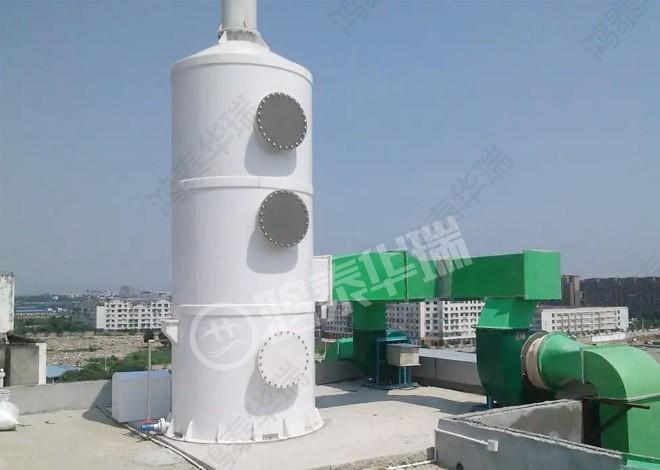
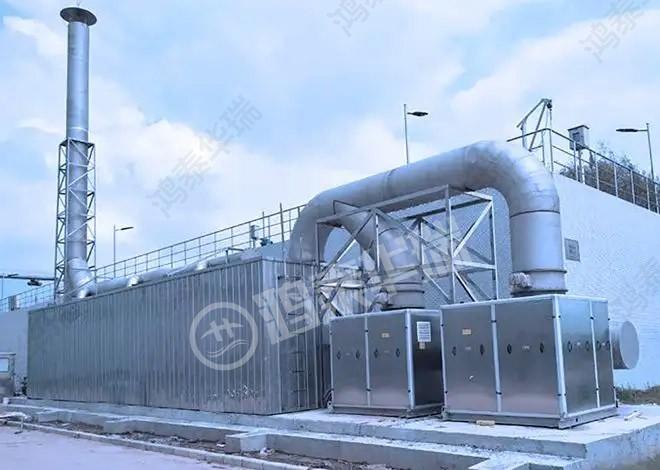
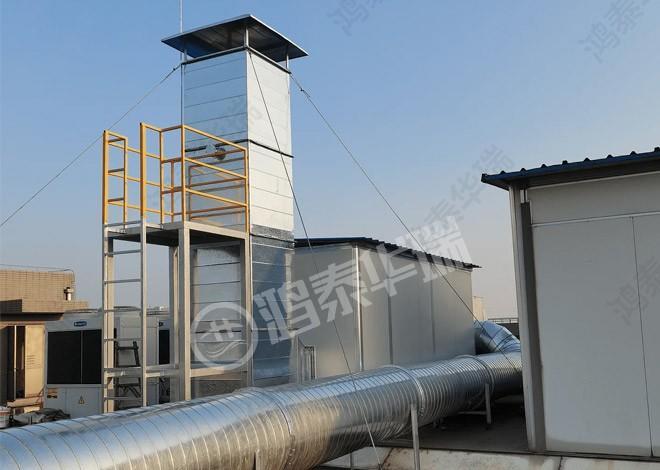
 Considering the operating cost and safety of the waste gas to be treated, the process route is planned to use "ventilation system (pipeline, draft fan) + pretreatment system (purification tower) + whitening system (electromagnetic whitening equipment) + deep purification system (RTO)" as the core process to treat the waste gas.

>> Process Introduction

     (1) When the collected exhaust gas enters the whitening system, when the flue gas passes, the dust and tar in the flue gas are ionized under the action of electric charge, move to the metal wire and pipe wall with electric charge, and lose the charge, under the action of gravity, fall to the bottom of the electromagnetic whitening equipment and flow out, so that the pollutants can be degraded and removed.
     (2) The treated exhaust gas enters the deep purification system, the exhaust gas enters the heat storage chamber for heating, absorbs the heat stored in the heat regener, and then enters the incineration chamber for further combustion, heating up to the set temperature, in which the exhaust gas components are completely decomposed into CO2and H2O, discharged through the fan pipeline to meet the standard.

Handling indicators

      The exhaust gas emission standards shall implement the secondary standards of the "Comprehensive Emission Standard for Air Pollutants" (GB16297-1996) and the "Emission Standard for Odorous Substances" (GB14554-93).

Project construction drawings

the overview of this text: