hthrjt2017@gmail.com
Renovation project of wastewater treatment station of a meat processing factory in Yunnan
- release date: 2022-08-20 02:25:00
- author: Hongtai Huairui
- Reading: 4892
key words: Yunnan, meat processing, wastewater treatment
Hongtai Huarui Technology Group welcomes your visit. We have been dedicated to the environmental protection and governance industry for over a decade! We look forward to a cooperation with you!


+86 19102876179 +86 400-669-0860

key words: Yunnan, meat processing, wastewater treatment
project overview
The meat processing plant is a wholly-owned subsidiary of a large group. It is a newly built pig slaughtering and meat product deep processing plant invested by the group. It was officially put into operation on September 8, 2010. The processing plant is currently the largest domestic meat food processing enterprise introduced by Yunnan. It is a comprehensive meat food company integrating livestock and poultry slaughtering, meat food processing, online sales, biopharmaceutical and leather primary processing. The company has a total investment of 497 million yuan, covers an area of 167,000 m2(300 acres), and a construction area of 53,000 m2. It has purchased 36 domestic advanced slaughtering equipment (sets) and has an automatic production line. The newly built cold storage has a storage capacity of more than 6000 tons, the annual number of pigs slaughtered reaches 2 million, and deep processing of 20,000 tons: an annual output of cold fresh meat and frozen meat is 140,000 tons.
The meat processing plant currently has a wastewater treatment station with a designed treatment capacity of 2000m3/d to uniformly collect and treat domestic wastewater and production wastewater generated in the plant. However, the actual treatment capacity of the wastewater treatment station has not reached the design capacity, and the company is currently trying to expand the production scale, so the existing wastewater treatment station can no longer meet the requirements
Based on the actual situation of the processing plant, the original wastewater treatment station was renovated and expanded, and the designed treatment scale reached 3000m3/d to ensure the company's need to expand production scale. After treatment, the quality of the discharged water meets the first-class standard for livestock processing in the "Discharge Standards for Water Pollutants in the Meat Processing Industry"(GB13457-92), and the other part of the effluent meets the "Urban Waste Water Reutilization" Water Quality)(GB18920-2002), and is reused for greening water in the factory area.
Design basis
(1) Technical Specification for Wastewater Treatment Engineering for Slaughtering and Meat Processing (HJ2004-2010);
(2) "Urban River Water Recycling and Urban Miscellaneous Water Quality" (GBT18920-2002)
(3) Water Pollutant Discharge Standard for Meat Processing Industry (GB13457-92)
(4) Various relevant basic information provided by the builder (water quality, water quantity, discharge and reuse standards, etc.);
(5) On-site survey data,
(6) The spirit of relevant national, provincial and regional laws, regulations and documents,
(7) Other relevant design codes and standards
Design principles
(1) Conscientiously implement the national guidelines and policies on environmental protection, so that the design complies with relevant national regulations, norms and standards.
(2) Comprehensively considering the characteristics of wastewater quality and quantity, the selected treatment process should be technologically advanced, stable and reliable, economical and reasonable, flexible in operation, safe and applicable.
(3) Properly treat and dispose of sludge and scum generated during wastewater treatment to avoid secondary pollution:
(4) The automatic control system of the wastewater reuse treatment system should be convenient to manage, safe and reliable, economical and practical:
(5) The layout of the wastewater reuse treatment system should strive to be compact, reduce land occupation and investment, and the elevation layout should adopt a three-dimensional layout as much as possible to make full use of the underground space:
(6) Properly consider the development prospects of the enterprise and leave room for design:
(7) Design in strict accordance with the defined conditions of the construction party to adapt to the actual situation of the project.
Source of pollution
Domestic wastewater and production wastewater generated in the factory area
Processing technology
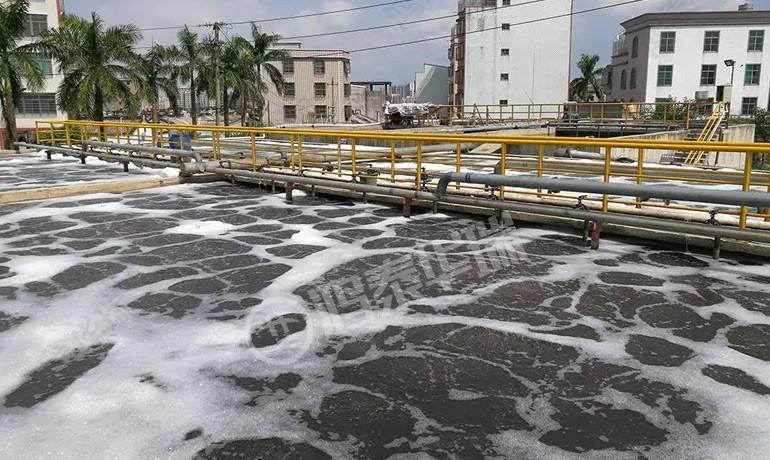
The original wastewater treatment station adopts the combined treatment process of "oil sedimentation + air flotation + hydrolysis and acidification + oxygen + contact oxidation + disinfection", the specific process flow is shown in Figure 2

Fig. 2 Wastewater treatment process of the original wastewater treatment station
Handling indicators
The wastewater treatment station is a renovation and expansion project, based on the information provided by the construction party, and the wastewater source of the wastewater treatment station consists of two parts. That is, the total design wastewater of production wastewater and plant domestic wastewater is 3000m3/d.
The design wastewater influent water quality indicators are shown in Table 1
Table 1 Design wastewater influent water quality

3.2 Design effluent quality
According to the requirements of the construction party, the treated wastewater effluent is directly discharged in two parts, one part of which meets the first-level standard of livestock slaughtering and processing in the "Meat Processing Industry Water Waste Discharge Standard" (GB13457-92), as shown in the table, part of it is reused for sprinkler irrigation, watering, toilet flushing and non-direct contact with landscape water and other purposes, and the "Urban Sewage Recycling Urban Miscellaneous Water Quality Standard" (GB/T18920-2002), the specific reuse water quality requirements are shown in Table 3
Table 2 Design wastewater discharge techniques

Table 3 Water quality requirements for reuse water

Previous Article:Linyi Ecological Circulation Industrial...
Next Article:Beef processing wastewater treatment pro...
The content you might be interested in

Environmental Protection Information


Recommended Products